Wetherspoon dumps social media

Ha! I’m not the only one who thinks you can live without Facebook etc. Ironically  JD Wetherspoon, the British pub chain, used Twitter to tell its 44,000 followers that it is quitting social media – Twitter, Instagram and Facebook – immediately.

julian-gentilezza-414681-unsplash

The chain’s iconic founder and chair, Tim Martin, cited the bad publicity surrounding social networks in an interview with the BBC, giving particular mention to the trolling of MPs, misue of personal data and its addictive nature. I’d like to add Narcissm and fear of missing out as two evils it can encourage. Wetherspoon’s  no social media policy will apply to the company’s social profile and those of individual employees.

He said, “We are going against conventional wisdom that these platforms are a vital component of a successful business” and that he’d always thought the idea that social media was essential for advertising was untrue. Martin also stated, “I don’t believe that closing these accounts will affect our business whatsoever.”

Martin has been accused of pulling a stunt. Probably not, I’d say. He was way ahead of the game when he decided, in July 2017, to deleted its entire email marketing database stating: “Many companies use email to promote themselves, but we don’t want to take this approach, which many consider intrusive”.

Different Martins – same thorny issue

Interesting that this happened two days after Sir Martin Sorrell resigned as CEO from the world’s biggest advertising group, which he’d built up over 33 years. Looks like he was forced out by a combination of allegations of  “improper conduct” and poor trading figures.

Advertising is at a pivotal moment. Fewer people are watching less traditional TV and spending more time online. Yet advertising agencies’ customers seem less than convinced about social media’s value as an advertising channel – we are adept at skipping corporate ads and now big brands are running scared of the abuse and misuse of users’ personal data.

To stop Facebook tracking you, you gotta sign up

And acutally, Facebook collects data about people don’t have an account – as I discovered when i was forced, temporaily, to open an account to access some information for work. But here’s Rowland Manthorpe, someone else who hates Facebook, writing in a Wired, article entitled, Dear Mark, this is why I hate you. An open letter to Zuckerberg, pointing out that the only way to stop Facebook tracking you on the web is to sign up. How can that be right?

Zuckerberg’s idea that getting obscenely rich and doing it for the common good is rubbish. Wouldn’t it be fun to sue and share those billions around?


Wha……?

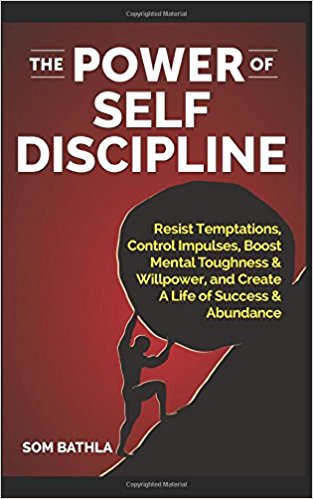
Ploughing through a pitch for business that has to go out today. Fidgeting, this catches my eye in the recommendations on the Amazon page I have open – The Power of Self Discipline: Resist Temptations, Control Impulses, Boost Mental Toughness & Willpower, and Create A Life of Success & Abundance.

Oh, I think, I could definitely do with some of that. I read on: “Does every little distraction drift you instantly from your most important task?”

Which of course is exactly what I’m doing reading the blurb for this book when I should be concentrating on my pitch……odd use of “drift” too.

self-discipline book cover April 2018

Not lean in, but duck out

Sheryl Sandberg is the Chief Operating Officer of Facebook – second in command. She first became known outside geeksville for her book urging women to have the confidence to do better at work and get into positions of leadership – Lean In. Check out the video below. Rather less happily, she was widowed suddenly and her next book was about surviving such a terrible blow.


She is very bright, coherent and a terrific communicator. All of which put her in a very bad light regarding the shameful shenanigans at Facebook. She has no excuse.

So here we are with this super brainy woman who kept her mouth shut, like her boss and FB co-founder Mark Zuckerberg, for five days after the Cambridge Analytica scandal broke. And what does Ms Sandberg say in an interview with the Financial Times?

That she’s sorry – mistakes were made and they are on her. That Facebook still doesn’t know what data Cambridge Analytica has. That her company had underinvested in the safety and security of people’s data.

What? This isn’t about pushing someone over in the playground. Or coming clean before she was absolutely forced to. This is about helping a Narcissistic maniac who has never held public office become President of the US and much other mischief, setting people against others all over the world.

Looting data and allowing others to do the same is how Facebook got so big and so rich so fast. It’s motto is “move fast and break things” – until called to account it didn’t seem to care that that included democracy, on both sides of the Atlantic – we are a long way from fully understanding the level of interference in the Brexit referendum.

I don’t buy Zuckerberg and Sandberg’s naivety that they didn’t grasp the implications of the monster they built. I think they didn’t care while they were raking in billions of advertising dollars. Don’t forget that in 2004 Zuckerberg described those 4,000 Harvard students who had handed over their data to him right at the start of what became Facebook “Dumb Fucks” for trusting him with it. How right he was.

Shamefacedness isn’t something Zuckerberg or his deputy know how to do. Still as Groucho Marks remarked, “Sincerity is the secret of success. Once you can fake that, you’re on your way”. And they’ve both had years of describing what FB does as being for the good of humanity with a straight face.

I have a terrible fear that once the hoo-ha is over, it will be business as usual. I  hope not, but I cannot see FB will change its business model or operations in any significant way.  I also cannot see  that the two people most responsible for creating this rampaging monster are the best ones to try and tame it. #DeleteFacebook. You can live without it. Honest.

Fabulous journalism, clueless marketing

I’m rejoicing in The Guardian and The Observer’s outstanding work getting people to see the damage done through improper use of data from Facebook – from helping get Trump elected to stirring up hatred and prejudice. In 2004, Facebook’s founder, Mark Zuckerburg, called people who gave Facebook their information “Dumb Fucks” then built a multi-billion dollar business on people’s ignorance and trust in the name of bringing folks together as a force for good.

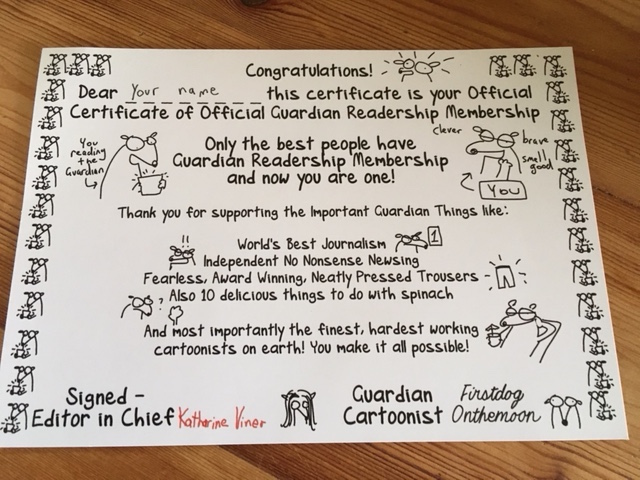
In fact, exploiting the data people entrust Facebook with is the company’s business model – no wonder Zuckerburg has struggled to find something appropriate to say. Sorry really doesn’t cut it. So great work that also enabled the Channel 4 expose Cambridge Analytica’s fabulous moral code…but am INFURIATED by this. I mean really, WTF?

IMG_0611

The Guardian is famously strapped for cash. Having renewed my Guardian membership means I support its journalism and the courage of its campaigns. So I am cross to see it fritter away any portion of my £49 a year on the postage, printing, paper and staff time needed to get this straight-in-the-bin certificate and accompanying letter to me. And to act in such an environmentally unfriendly way, recycled paper not withstanding.

Seriously unimpressed. Or is it just me?

White men don’t get busses

Went to a lecture/panel discussion called The Preston Model: How to Fix a City at the University of Central Lancashire last night. I will be writing a lot more about this, not least because it’s succeeding and the opposite of the usual approach.

I was much impressed by panellist Lisa Nandy, MP for Wigan (shown below) – a town in Greater Manchester fewer than 20 miles away from Preston, which faces many of the same issues caused by economic decline, aggravated by years of savage budget cuts.

Lisa Nandy MP Wigan

One of the problems small cities and towns in the UK face is that young people tend to leave them for larger, generally newer cities. One of Preston’s saving graces is that it has a university. Nandy said that elsewhere, this is a big problem exacerbated by weak infrastructure. She gave the example that Wigan has a large Heinz factory that is satisfied with the workforce, but struggles to recruit enough staff because of the “disgraceful state of public transport”.

She added that when there are policy discussions about public transport, busses are never on the agenda, it’s all about trains and planes, although the obvious, fastest solution, cheapest solution is providing more, affordable bus routes that people (and businesses) need.

A core theme of the evening was where the power lies, and the disconnects caused by decisions being made behind closed doors, typically by white men in suits who don’t live in the communities that will be affected. And the curse of London-centric thinking. Hence the decision to invest billion on a fast trainline, H2, to tear up thousands of acres of countryside in the interests of better linking the poor North and rich South – a southern fallacy that this is the only way to improve propserity in the North.

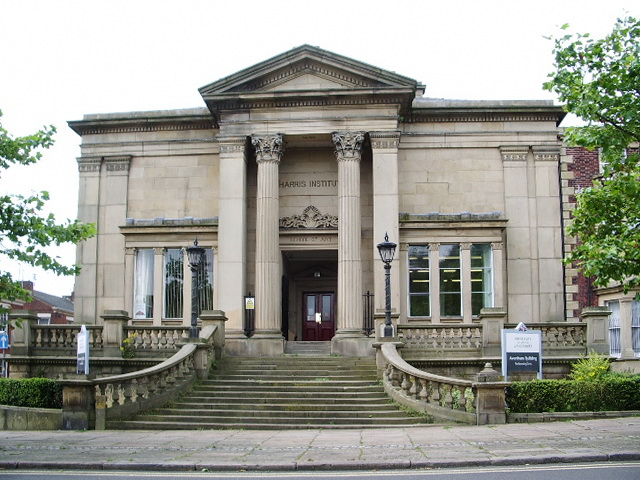
In fact, we need to improve the links between and within those small cities and towns, all over the country. And as my neighbour and I agreed, move Parliament to Bradford at the very least for the duration of the desperately needed refurbishment of its Victorian buildings. And maybe, like Preston Council did with some of the iconic Harris Bequest buildings, they could sell the buildings off. Who cares that, as my step-mother noted about the Harris Bequest, “The buildings were given to the people of Preston and didn’t belong to the Council to sell”? After all, we’ve flogged the rest of the nation’s silver, much of which was paid for by tax payers.Harris_Institute_(School_of_Art)_-_geograph.org.uk_-_506373

The Harris Institute in Avenham, Preston, which is in private ownership.

That white men don’t get (in either sense of the word) busses goes some way to explaining the scorn that has been heaped on the head of American inventor and entrepreneur Elon Musk, for enthusing about, “1000s of small stations the size of a single parking space that take you very close to your destination & blend seamlessly into the fabric of a city, rather than a small number of big stations like a subway”. Elon, they’re called bus stops, as so many users of social networks have had a field day pointing out.

Although of course, being Mr Musk, his busses would get lifts up to the surface from their uncongested routes below the surface, more like metros -– although surely that would slow things down terrifically? Check out the video. What do you think?


Cannot stand being wired any more

Took off underwired bra last night and vowed never to wear such a thing again. Spent an age online today looking for something that doesn’t ratchet your breasts up so they’re like a balcony preceeding you and not so uncomfortable. Couldn’t find a ‘proper’ bra except that cost the Earth and I’m doing that thing of not wanting to spend much money because I’m going to I lose weight etc.

Settled for these from Amazon, thinking if useless at least not much money down the suff [Lancashire for drain].


Screen Shot 2018-07-12 at 12.19.52.pngLove ’em. Soft, no cutting in and even though, please note, had to buy X-Large (I’m a size 12-14?!) pretty much keeps them in place and no nipples the size of walnuts through your shirt. I don’t want to look like a Barbie doll and never did and rather fed up with clothes manufacturers forcing us into being certain shapes.

No idea why I didn’t do it much sooner. Bugger burning your bra, just pull that fuse wire.


Stars, awards and just deserts

Students from the University of Bradford were so ticked off by the antics at a “sexist and inappropriate” awards ceremony that they’ve handed their prize back. And the woman who discovered pulsars 50 years ago explains why she’s OK about the Nobel Prize for her work going to someone else.

Makes you wonder whether the organisers of the Digital Entrepreneur Awards have heard about the fallout in Silicon Valley regarding sexist behaviour, gender pay gaps and how few women work in tech?

Women receiving awards at the Digital Entrepreneur event were regaled with sexist jokes against a backdrop of women who were almost wearing some clothes. Mark Garratt, External Affairs Director, University of Bradford said in a statement, “It was like going back to the days of Bernard Manning…We thought afterwards and we couldn’t possibly keep the award. The whole ceremony didn’t sit comfortably with what, as a university, we are trying to promote.”

Digital entrepreneur awards Nov 2017.jpg

Faced with a social media backlash, the organisers stated, “Our aim was to celebrate tech and never to undermine the incredible women in the industry or do anything to negate the work everyone in the industry is doing to promote equality and redress the balance”. Wonder what they’d have done had that been their aim? Tar and feathers?

No Nobel prize

Fifty years ago today a young PhD student, Jocelyn Bell Burnell, made what one of her colleagues described as “the greatest astronomical discovery of the 20th century”.

She had identified pulsars: small spinning stars only 19 miles across that are left behind when a normal star dies. The discovery was deemed worthy of the Nobel Prize in Physics but it was awarded to her [male] supervisors, not her.

She was asked how she felt about that on BBC Radio 4’s Today programme. She replied, “There is no Nobel Prize in Astronomy, nor for Mathematics…This was the first time the Nobel Community had deemed astro-physics to be good enough, if you like, to be given a physics prize. I was a student and they don’t recognise students, or they didn’t then, they have subsequently, but at that stage they were just the dross.

“I think I’ve done extremely well out of it because if you get a Nobel Prize, no-one gives you anything ever again as they feel they can’t match it, whereas if you don’t get a Nobel Prize, you get everything that moves, so there’s a party every year, more or less.”

She’s not kidding: Dame Jocelyn Bell Burnell DBE is a Fellow of the Royal Society and Visiting Professor of Astrophysics, Department of Astrophysics, University of Oxford,
Pro Chancellor, Trinity College Dublin. Class act or what?


Does my dick look big in this?

Having had a basinful of mansplaining yesterday from an ex-colleague I generally like a lot, I was cheered to come across an article on manspreading by Radhika Sanghani. She has some pithy comments to make about the infuriating habit some men have of spreading their legs so wide they squash their (typically female) neighbours on planes, trains and other seating.

Mansplaining and manspreading resonate so well because they are both self-explantory and common. As a girl we are told to be ladylike, to sit up properly and keep out legs together – ie take up less space and not draw attention to our gender. My Dad had an absolute bee in his bonnet about it with me as I had a habit of sitting on the floor.

I had a bee in mine about manspreading when I lived in London and was frequently squashed by akimbo male thighs on the Tube –  worse case a spreader on either side. I always assumed the culprits’ idea was to convey they were too well endowed to put their legs together. In yer dreams, buster. Just selfish, oafish, arrogant and aggressive encroachment into others’ space – but I noted not into others who looked big enough to push back.

In short, emphasising proud ownership of male genitalia is viewed in a very different light from allegedly drawing attention to having a vagina – not clamping your knees  together – or as Freud would have it, a lack of [proper] genitals.

Which reminds me of a joke a very proper gentleman and former matelot told me in the village pub when I used to frequent it. A small boy and little girl agreed if-you-show-me-yours-I’ll-show-you-mine. Shocked, the lad pointed out the lass’s perceived lack. She replied, pointing to her privates, “With one of these, I can get as many of those [pointing to his] as I like”.


Up to her arse in culture

Delighted to see accounts of persistent women at the York Castle Museum today, less impressed with the real-life groper and sad about the death of the Archduchess and the catastrophe that followed.

York is world-famous for its chocolate and confectionary. In 1725, pioneering Mary Tuke set up business in Walmgate, York, dealing in tea and cocoa, for which she required a licence to trade from the boys’ club known as the Company of Merchant Adventurers (check out its 660 year-old HQ below). Despite constant harrassment for trading without the licence, including threats of imprisonment, Mary continued. After seven years she agreed to pay a fine and was allowed to trade in peace. Later she apprenticed her nephew who took over her shop in 1752.
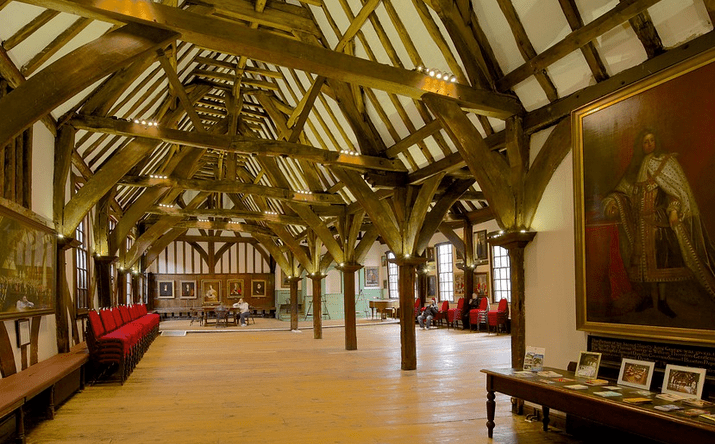
Screen Shot 2017-11-20 at 12.23.37

A century later came another remarkable business woman – Mary Anne Hick,  daughter of York-based confectioner Joseph Hick. She also married a confectioner, Thomas Craven, who had established his own firm in High Ousegate (York is built on the Rivers Ouse and Foss).

When both men died in quick succession, Mary Anne merged the two companies and ran the enterprise successfully for 40 years, until her death in 1902. Craven’s was taken over in 1998 by another famous British chocolate maker, Cadbury’s (which started out in Birmingham, in the English Midlands) and is now owned by Tangerine. I don’t know who Tangerine is, but greatly fear some huge American conglomerate like the ones that swallowed Cadbury’s, Rowntree et al.

Up to her arse in culture

While in the Shaping the Body exhibition, some bloke stepped back out of my sister Harriet’s way, ostensibly politely, and took the opportunity to guide her past him with his hand feeling her arse. She said she didn’t mention it to me at the time because I’d have kicked off. TFR. #metoo

And still on the subject of poisonous things, the exhibition said that the average Georgian (meaning in this instance anyone who was a subject of any run of British Kings George I-III in the eighteenth century) ate about 15 pounds of sugar a year. Brits now consume the equivalent of their steadily rising body weight a year. Funny that.

Sick chic

Choked rather on reading how women in the mid nineteenth century went in for TB (tuberculosis often referred to as consumption) chic in the same exhibition. It was v fashionable, according to research by the American academic Dr Carolyn A Day for women to imitate the flushed look of the consumptive (pinched cheeks and rouge) and some clothes – such as specially designed corsets – even forced the hunched stance that is characteristic of the disease.

Bloody hell – defo taking the little old helpless me act too far, especially in combo with being corralled in crinolines and bustles, and corsets so tight they made women faint.  Things got a bit better in the early twentieth century,  as the exhibit showed when they wore layers and layers of cloth (well, those who could afford it did – think Mrs Honeychurch in the Merchant-Ivory film Room with a View ) before more comfortable and practical clothes became de rigueur after the Great War.

Hmm, we’ve made staggering progress, with some of us choosing to totter about in heels that bugger our backs, knees, calves, ankles, feet and hips – and just don’t ask us to do owt difficult like walk. And still we have a fashion industry that insists on skeletal models.

Death of a duchess

The Museum’s exhibit of the Great (First World) War, 1914: When the World Changed Forever (that use of forever really should be outlawed) does a terrific job of explaining how the assassination of the Austrian Archduchess Sofia and her husband led to the death and suffering of tens of millions of people all over the world.

Here we read about the life of local lass Alice Battersby who was one of 6,000 woman who joined the Women’s Auxiliary Army Corps and served overseas. She worked in the pay office in the Supply Depot at Calais. Her superiors were most impressed by her work and wanted to promote her, but found they couldn’t because there was no position to promote a woman to.

The Great War was ended by the Armistice at the eleventh hour of the eleventh day of the eleventh month of 1918. Edith Appleton, a nurse working in France, wrote of it, “Peace, thank god for that. It feels very queer [odd] too as if our elastic had snapped.”

I fled prison

I ran out of the Women’s Prison part of the Musuem. One can imagine only too well the petty tyrannies inflicted on the helpless and hapless inmates – and the none petty too – indeed from the little I saw, this is the angle the museum emphasized. Ugh. Surely things are oh so much better now?

According to Ministry of Justice (sic) figures, a record number, 119 people, killed themselves in prisons in England and Wales in 2016 – an increase of 29 (32%) on the previous year. The rise in jail suicides has been accompanied by a 23% increase in incidents of self-harm, to a total of 37,784. Some 1,864 prisoners in England and Wales have killed themselves while in custody since 1992.

Professor Pamela Taylor of the [British] Royal College of Psychiatrists’ forensic faculty, told The Guardian newspaper, “The prison service is in crisis following a 40% cut in the number of prison officers, and mental health teams are struggling to help prisoners in desperate need. In many cases, there is no-one available to escort prisoners to in-prison clinics from time to time: even when a psychiatrist goes to a prisoner’s cell, as there are not enough prison officers present and the cell door can’t be unlocked for safety reasons.”

We urgently need a modern-day Elizabeth Fry – the eighteenth-century prison reformer who reshaped thinking about prisons, prisoners and their treatment after seeing the horrific conditions in Newgate Prison, which housed many debtors. Shame her husband was Joseph Fry, a tea merchant, rather than the Joseph Fry, whose company invented the first chocolate bar with a filling as I was on a bit of a roll (sorry) with that.

Still, in an interesting twist, our Mr Fry was a failed banker: he all but made his employer insolvent by lending huge sums to his wife’s family during the financial crisis of 1812. However, Elizabeth’s acumen and contacts saved him, so he didn’t end up in Newgate himself.