Went to a lecture/panel discussion called The Preston Model: How to Fix a City at the University of Central Lancashire last night. I will be writing a lot more about this, not least because it’s succeeding and the opposite of the usual approach.
I was much impressed by panellist Lisa Nandy, MP for Wigan (shown below) – a town in Greater Manchester fewer than 20 miles away from Preston, which faces many of the same issues caused by economic decline, aggravated by years of savage budget cuts.

One of the problems small cities and towns in the UK face is that young people tend to leave them for larger, generally newer cities. One of Preston’s saving graces is that it has a university. Nandy said that elsewhere, this is a big problem exacerbated by weak infrastructure. She gave the example that Wigan has a large Heinz factory that is satisfied with the workforce, but struggles to recruit enough staff because of the “disgraceful state of public transport”.
She added that when there are policy discussions about public transport, busses are never on the agenda, it’s all about trains and planes, although the obvious, fastest solution, cheapest solution is providing more, affordable bus routes that people (and businesses) need.
A core theme of the evening was where the power lies, and the disconnects caused by decisions being made behind closed doors, typically by white men in suits who don’t live in the communities that will be affected. And the curse of London-centric thinking. Hence the decision to invest billion on a fast trainline, H2, to tear up thousands of acres of countryside in the interests of better linking the poor North and rich South – a southern fallacy that this is the only way to improve propserity in the North.
In fact, we need to improve the links between and within those small cities and towns, all over the country. And as my neighbour and I agreed, move Parliament to Bradford at the very least for the duration of the desperately needed refurbishment of its Victorian buildings. And maybe, like Preston Council did with some of the iconic Harris Bequest buildings, they could sell the buildings off. Who cares that, as my step-mother noted about the Harris Bequest, “The buildings were given to the people of Preston and didn’t belong to the Council to sell”? After all, we’ve flogged the rest of the nation’s silver, much of which was paid for by tax payers.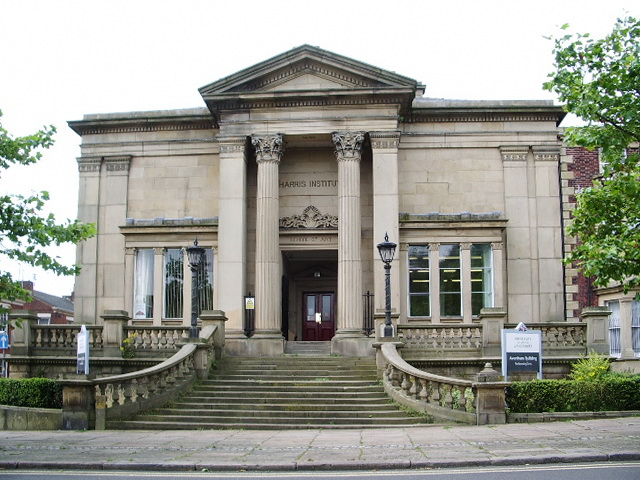
The Harris Institute in Avenham, Preston, which is in private ownership.
That white men don’t get (in either sense of the word) busses goes some way to explaining the scorn that has been heaped on the head of American inventor and entrepreneur Elon Musk, for enthusing about, “1000s of small stations the size of a single parking space that take you very close to your destination & blend seamlessly into the fabric of a city, rather than a small number of big stations like a subway”. Elon, they’re called bus stops, as so many users of social networks have had a field day pointing out.
Although of course, being Mr Musk, his busses would get lifts up to the surface from their uncongested routes below the surface, more like metros -– although surely that would slow things down terrifically? Check out the video. What do you think?

 The Persistent Woman