Delighted to see accounts of persistent women at the York Castle Museum today, less impressed with the real-life groper and sad about the death of the Archduchess and the catastrophe that followed.
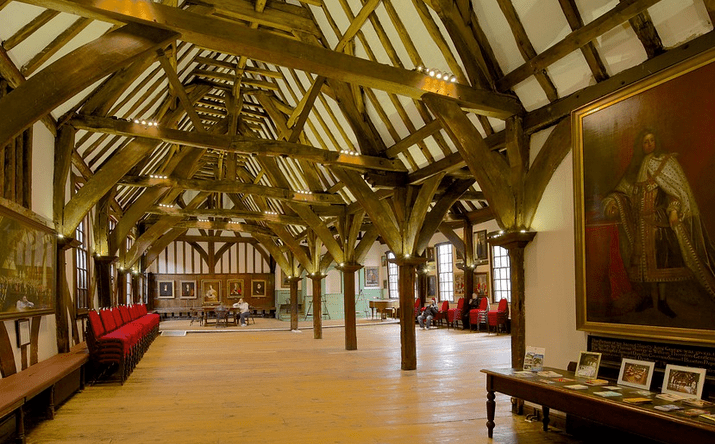
York is world-famous for its chocolate and confectionary. In 1725, pioneering Mary Tuke set up business in Walmgate, York, dealing in tea and cocoa, for which she required a licence to trade from the boys’ club known as the Company of Merchant Adventurers (check out its 660 year-old HQ below). Despite constant harrassment for trading without the licence, including threats of imprisonment, Mary continued. After seven years she agreed to pay a fine and was allowed to trade in peace. Later she apprenticed her nephew who took over her shop in 1752.
A century later came another remarkable business woman – Mary Anne Hick, daughter of York-based confectioner Joseph Hick. She also married a confectioner, Thomas Craven, who had established his own firm in High Ousegate (York is built on the Rivers Ouse and Foss).
When both men died in quick succession, Mary Anne merged the two companies and ran the enterprise successfully for 40 years, until her death in 1902. Craven’s was taken over in 1998 by another famous British chocolate maker, Cadbury’s (which started out in Birmingham, in the English Midlands) and is now owned by Tangerine. I don’t know who Tangerine is, but greatly fear some huge American conglomerate like the ones that swallowed Cadbury’s, Rowntree et al.
Up to her arse in culture
While in the Shaping the Body exhibition, some bloke stepped back out of my sister Harriet’s way, ostensibly politely, and took the opportunity to guide her past him with his hand feeling her arse. She said she didn’t mention it to me at the time because I’d have kicked off. TFR. #metoo
And still on the subject of poisonous things, the exhibition said that the average Georgian (meaning in this instance anyone who was a subject of any run of British Kings George I-III in the eighteenth century) ate about 15 pounds of sugar a year. Brits now consume the equivalent of their steadily rising body weight a year. Funny that.
Sick chic
Choked rather on reading how women in the mid nineteenth century went in for TB (tuberculosis often referred to as consumption) chic in the same exhibition. It was v fashionable, according to research by the American academic Dr Carolyn A Day for women to imitate the flushed look of the consumptive (pinched cheeks and rouge) and some clothes – such as specially designed corsets – even forced the hunched stance that is characteristic of the disease.
Bloody hell – defo taking the little old helpless me act too far, especially in combo with being corralled in crinolines and bustles, and corsets so tight they made women faint. Things got a bit better in the early twentieth century, as the exhibit showed when they wore layers and layers of cloth (well, those who could afford it did – think Mrs Honeychurch in the Merchant-Ivory film Room with a View ) before more comfortable and practical clothes became de rigueur after the Great War.
Hmm, we’ve made staggering progress, with some of us choosing to totter about in heels that bugger our backs, knees, calves, ankles, feet and hips – and just don’t ask us to do owt difficult like walk. And still we have a fashion industry that insists on skeletal models.
Death of a duchess
The Museum’s exhibit of the Great (First World) War, 1914: When the World Changed Forever (that use of forever really should be outlawed) does a terrific job of explaining how the assassination of the Austrian Archduchess Sofia and her husband led to the death and suffering of tens of millions of people all over the world.
Here we read about the life of local lass Alice Battersby who was one of 6,000 woman who joined the Women’s Auxiliary Army Corps and served overseas. She worked in the pay office in the Supply Depot at Calais. Her superiors were most impressed by her work and wanted to promote her, but found they couldn’t because there was no position to promote a woman to.
The Great War was ended by the Armistice at the eleventh hour of the eleventh day of the eleventh month of 1918. Edith Appleton, a nurse working in France, wrote of it, “Peace, thank god for that. It feels very queer [odd] too as if our elastic had snapped.”
I fled prison
I ran out of the Women’s Prison part of the Musuem. One can imagine only too well the petty tyrannies inflicted on the helpless and hapless inmates – and the none petty too – indeed from the little I saw, this is the angle the museum emphasized. Ugh. Surely things are oh so much better now?
According to Ministry of Justice (sic) figures, a record number, 119 people, killed themselves in prisons in England and Wales in 2016 – an increase of 29 (32%) on the previous year. The rise in jail suicides has been accompanied by a 23% increase in incidents of self-harm, to a total of 37,784. Some 1,864 prisoners in England and Wales have killed themselves while in custody since 1992.
Professor Pamela Taylor of the [British] Royal College of Psychiatrists’ forensic faculty, told The Guardian newspaper, “The prison service is in crisis following a 40% cut in the number of prison officers, and mental health teams are struggling to help prisoners in desperate need. In many cases, there is no-one available to escort prisoners to in-prison clinics from time to time: even when a psychiatrist goes to a prisoner’s cell, as there are not enough prison officers present and the cell door can’t be unlocked for safety reasons.”
We urgently need a modern-day Elizabeth Fry – the eighteenth-century prison reformer who reshaped thinking about prisons, prisoners and their treatment after seeing the horrific conditions in Newgate Prison, which housed many debtors. Shame her husband was Joseph Fry, a tea merchant, rather than the Joseph Fry, whose company invented the first chocolate bar with a filling as I was on a bit of a roll (sorry) with that.
Still, in an interesting twist, our Mr Fry was a failed banker: he all but made his employer insolvent by lending huge sums to his wife’s family during the financial crisis of 1812. However, Elizabeth’s acumen and contacts saved him, so he didn’t end up in Newgate himself.

 The Persistent Woman